
Luxury Product Photography Setup: How to Photograph Jewelry on Premium Backdrops (2026)
Posted on Jun. 23, 2026
There is a particular quality of light that only reveals itself when a diamond meets a hand-painted surface. The facets catch the studio source and scatter it, yes, but the canvas beneath does something unexpected: it absorbs the spill, holds the shadow, and returns a luminous ground that makes the stone appear to float in its own atmosphere. This is the moment when a jewelry photograph stops being documentation and becomes something closer to portraiture, where the surface and the subject are in conversation.
Luxury product photography for jewelry demands a backdrop that collaborates with reflective metals and refractive stones rather than competing with them. Hand-painted canvas backdrops bring the dimensional depth, controlled light absorption, and tonal nuance that fine jewelry photography requires, qualities that no printed vinyl, seamless paper, or machine-made surface can replicate. For photographers and art directors shooting for brands whose work appears in editorials, luxury e-commerce campaigns, and gallery-quality print, the surface beneath the piece is as consequential as the lighting above it.
We build every Chasing Stone canvas by hand precisely because this category of photography punishes shortcuts. Jennifer paints each backdrop over two to three days, layering pigment in deliberate passes that create the kind of micro-texture and tonal variation a jeweler's loupe would approve of. When a client photographs a platinum pavé band on one of our Graphite canvases, the surface responds to the same light source with its own quiet dimensionality, the brushstroke ridges casting micro-shadows that ground the piece without distraction. That interaction between painted surface and precious object is what separates an image that sells from an image that simply shows.
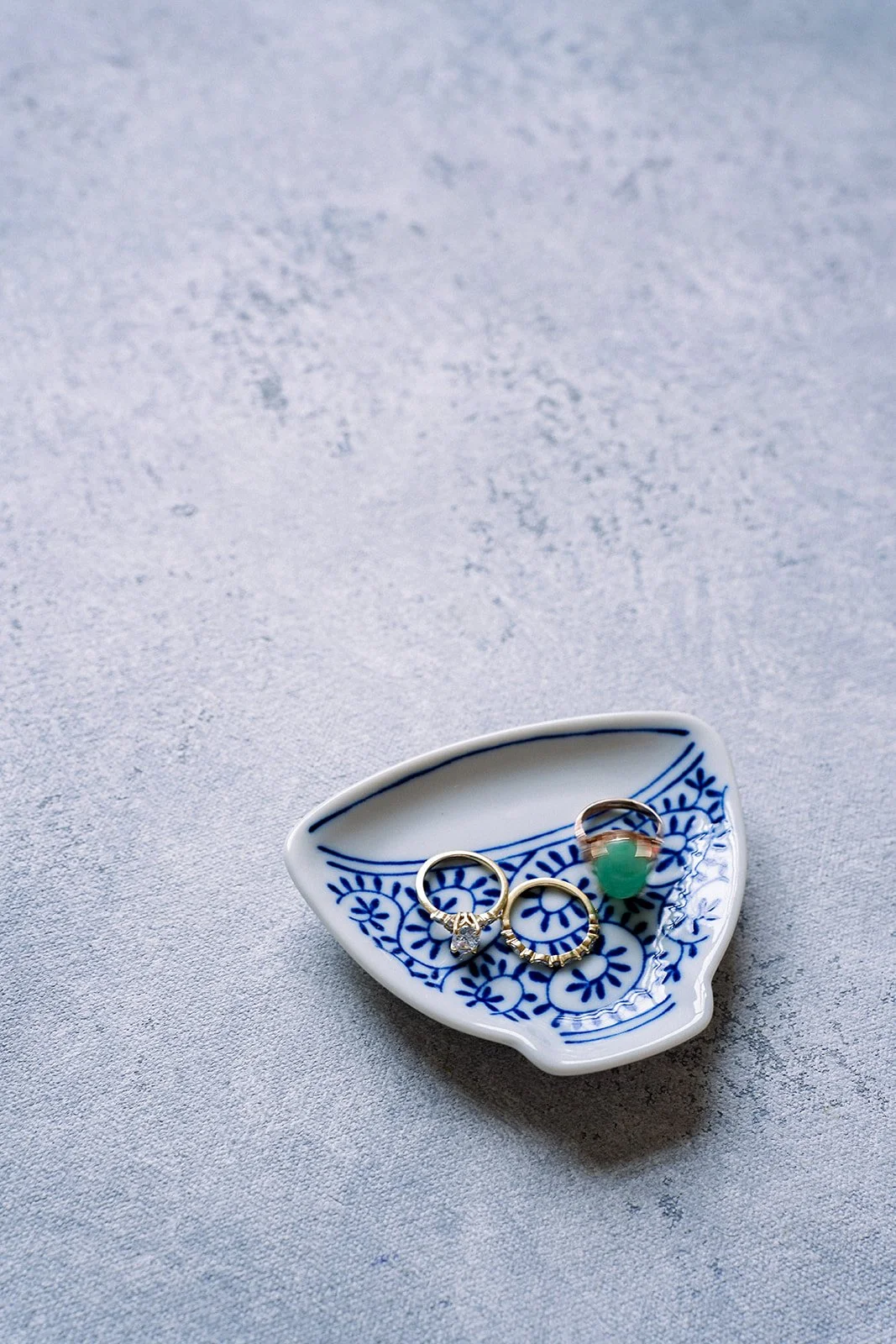
We hear from product photographers all the time: 'My jewelry shots always look flat, no matter what I try.' Nine times out of ten, it is the surface. This is CELESTITE, and this is what happens when the ground beneath the piece is actually working with the light instead of against it.
Quick Answer
Luxury jewelry photography demands a surface that absorbs and diffuses light rather than reflecting it back into the lens. Hand-painted canvas backdrops from Chasing Stone, starting at $497 for a 5x8 ft surface, provide the tonal depth and non-reflective texture that fine jewelry requires for editorial and e-commerce imagery. Pair warm earth-tone canvases with gold and rose gold pieces, cool neutrals with silver and platinum, and deep charcoal or carbon tones with diamond-forward compositions. Shoot at f/8 to f/11, ISO 100, with a dedicated macro lens in the 85mm to 105mm range, and use focus stacking for edge-to-edge sharpness across the piece.
Why Surface Choice Defines Luxury Jewelry Photography
The physics of light interaction determines whether a jewelry photograph reads as luxury or commodity. Every surface material in a photographer's toolkit behaves differently when studio light reaches it, and that behavior dictates how the jewelry itself is rendered. This is not a matter of preference. It is optics.
Vinyl and acrylic surfaces reflect light specularly. The photons hit the smooth polymer and bounce back at predictable angles, creating hot spots that compete with the jewelry's own reflective properties. When you are photographing a piece whose entire value proposition lives in its ability to catch and return light, the last thing the image needs is a surface doing the same thing. The result is visual noise: competing highlights, confused reflections, and a flattened tonal range that makes a $15,000 engagement ring look like costume jewelry in a display case.
Hand-painted cotton canvas operates on fundamentally different physics. The woven fiber absorbs light rather than bouncing it, and the multiple layers of pigment that Jennifer applies over two to three days create a surface with genuine optical depth. Light enters the paint layers, scatters within them, and returns as a soft, diffused luminosity. The effect is a ground that glows without competing, that has visual presence without visual noise. For a comprehensive look at the differences between hand-painted canvas backdrops and synthetic alternatives, our material comparison covers the technical distinctions in detail.
This is why the world's leading jewelry photographers and luxury brand art directors source hand-painted surfaces for campaign work. The surface is not merely behind the product. It is actively shaping the quality of light in the frame. A hand-painted canvas with three or four layers of carefully applied pigment behaves the way a gallery wall behaves when a painting hangs upon it: it recedes, supports, and elevates without ever announcing itself.
Hand-painted cotton canvas absorbs and diffuses studio light, while vinyl and acrylic surfaces reflect it specularly, creating hot spots that compete with the jewelry's own reflective properties and flatten the tonal range of the image.
There is a practical dimension as well. Because canvas absorbs rather than reflects, your lighting setup becomes simpler. You spend less time flagging and carding to control unwanted reflections from the surface, which means more of your session time is devoted to lighting the jewelry itself. For commercial shoots billed by the hour or the image, that efficiency translates directly to margin.
Matching Backdrop Color to Jewelry Metal and Stone
Color theory in jewelry photography is not decorative. It is functional. The backdrop color determines the color temperature of the reflected fill light that wraps around the underside of a ring, the interior of a chain link, the shadowed facets of a stone. Choose the wrong surface tone and the piece reads muddy. Choose the right one and the metal seems to generate its own internal luminosity.
The principle is straightforward: warm metals (yellow gold, rose gold, brass) gain depth and richness against warm earth-tone canvases, while cool metals (silver, platinum, white gold, rhodium-plated pieces) achieve their cleanest rendering against cool neutral or deep-toned surfaces. But the nuance lives in the specifics. Here is how Chasing Stone's hand-painted colorways map to the metals and stones most commonly photographed in luxury product work.
Recommended Chasing Stone Backdrop Colorways by Jewelry Metal Type and Session Style (2026)
| Metal / Stone Type | Recommended Colorways | Why It Works | Session Context |
|---|---|---|---|
| Yellow Gold | Clay, Sandstone, Limestone | Warm canvas tones amplify gold's inherent warmth without shifting it orange | Editorial, brand campaign, lookbook |
| Rose Gold | Rose-Quartz, Rhodonite, Sandstone | Pink and mauve undertones harmonize with copper-alloy warmth | Bridal jewelry, Valentine's campaign, social media |
| Silver / Platinum / White Gold | Slate, Graphite, Silt, Celestite | Cool neutral surfaces let silver metals read clean and precise without color contamination | E-commerce, editorial, architectural jewelry |
| Diamond-Forward Pieces | Carbon, Graphite, Umber | Deep tones maximize contrast, making facets and fire visually dominant | Hero shots, campaign imagery, print advertising |
| Colored Gemstones | Silt, Limestone, Bentonite | Neutral mid-tones avoid clashing with saturated stone color while providing soft contrast | Catalog, editorial feature, collector-focused content |
| Mixed Metals / Multi-Stone | Bentonite, Limestone, Mica | True neutrals with subtle warmth accommodate diverse material palettes without favoring one element | Collection overview, multi-piece editorial, styled sets |
When we say Slate, we mean a concrete-like architectural gray, not a dark or jewel-toned surface. It is one of our most requested colorways for product photography precisely because its neutral character lets the jewelry command attention without chromatic interference. Paired with platinum or white gold, Slate provides the visual equivalent of a gallery wall: present, composed, invisible.
For photographers building a product photography kit, the strategic move is to own one warm and one cool canvas. A Limestone and a Graphite, for example, cover the vast majority of jewelry metal types. Add a Carbon for diamond drama and you have a three-surface kit that serves every brief a luxury jewelry client will send.
A three-canvas kit of Limestone (warm neutral), Graphite (deep cool), and Carbon (near-black) covers virtually every metal type and session style in luxury jewelry product photography.
Camera Settings for Jewelry on Canvas Backdrops
Jewelry photography is one of the few disciplines where camera settings are non-negotiable rather than creative choices. The margin for technical error is measured in fractions of a millimeter, and the canvas surface adds its own set of considerations to the equation.
Set your aperture between f/8 and f/11. This range delivers the depth of field necessary to hold an entire ring or pendant in sharp focus from front facet to rear setting, while keeping the canvas backdrop's texture perceptible but not distractingly sharp. At f/5.6 or wider, the canvas reads as an impressionistic blur that loses its hand-painted character. At f/16 or narrower, diffraction softens the image across the frame, a particular problem when you need the engraving on a band to read at 100% crop. Our camera settings guide for backdrop photography covers these aperture-distance relationships in greater depth.
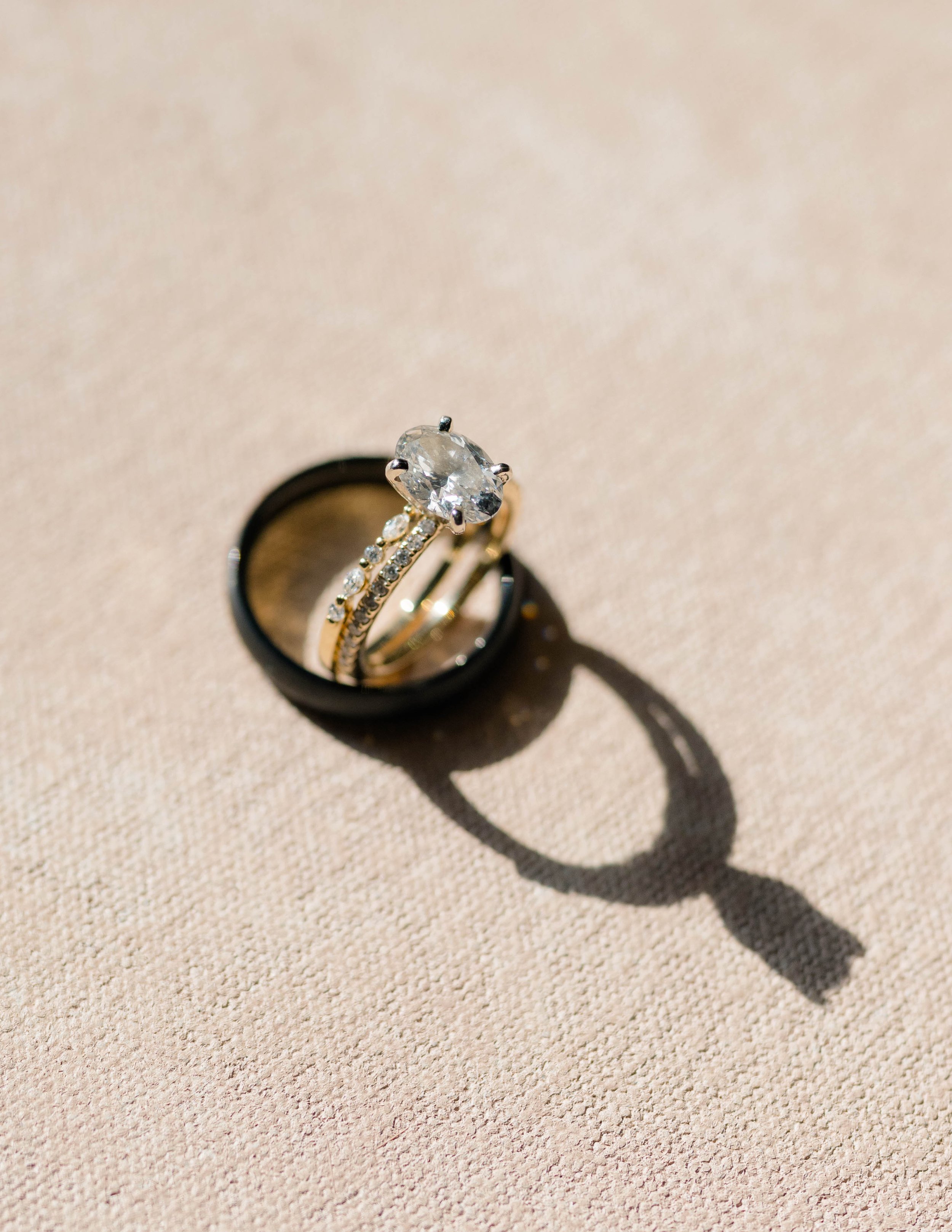
Oval diamond. Black ceramic band. A warm canvas that makes the shadow as beautiful as the stone. Shop hand-painted canvases and fabric flat lays at chasingstone.com.
Keep ISO at 100. Jewelry photography amplifies sensor noise because the viewer examines these images at extreme magnification. A noisy shadow area in a portrait is invisible at normal viewing distance. A noisy shadow inside a channel setting is immediately apparent at the crop levels jewelry clients demand. There is no reason to raise ISO when the subject is stationary, the camera is tripod-mounted, and the lighting is continuous or flash-synced.
For lens selection, the 85mm to 105mm macro range is the industry standard for a reason. These focal lengths minimize barrel and pincushion distortion (which can make a round bezel appear oval), provide a comfortable working distance between lens and subject (critical when you are flagging and carding reflections), and resolve the fine detail that a jeweler's loupe would reveal. The Canon RF 100mm f/2.8L Macro, Nikon Z MC 105mm f/2.8 VR S, and Sony FE 90mm f/2.8 Macro G are the lenses most frequently seen on commercial jewelry sets.
For luxury jewelry photography on canvas backdrops, shoot at f/8 to f/11, ISO 100, with an 85mm to 105mm dedicated macro lens. This configuration delivers edge-to-edge sharpness on the piece while rendering the hand-painted canvas texture with perceptible but non-distracting depth.
White balance deserves particular attention when shooting on hand-painted surfaces. Because the canvas pigment has its own color temperature (warm canvases like Clay will push reflected fill toward amber, cool canvases like Celestite toward blue), set a custom white balance using a gray card placed at the jewelry's position rather than relying on auto white balance. This ensures the metal reads true to the eye while the canvas renders with its intended tonality.
The Art of Focus Stacking on Textured Canvas Surfaces
Single-capture depth of field, even at f/11, rarely spans the full dimension of a three-dimensional jewelry piece photographed at macro distances. A solitaire diamond ring shot from a 30-degree angle presents a depth challenge that extends from the prong tips at the front to the shank curve at the rear, a distance that can exceed the depth of field at any non-diffraction aperture. Focus stacking solves this by blending multiple exposures, each focused at a different plane, into a single image with edge-to-edge sharpness across the entire piece.
The technique requires three to fifteen frames per final image, depending on the piece's depth, your shooting angle, and the intended output size. A simple stud earring photographed from directly above might need only three frames. A multi-row diamond bracelet shot at a shallow angle for a full-page print advertisement might demand twelve to fifteen. The standard approach is to shoot at f/5.6 to f/8, where the lens resolves at its sharpest, and let the stacking software (Helicon Focus, Zerene Stacker, or Adobe Photoshop's Auto-Blend Layers) handle the composite.
Hand-painted canvas introduces a specific advantage to focus stacking workflows. Because the canvas texture is organic and irregular, the transition zones between in-focus and out-of-focus areas blend more naturally than they would on a smooth, uniform surface. On vinyl, the hard edge between sharp and soft is visually obvious and creates distracting halo artifacts. On canvas, the textural variation disguises the blend boundaries. The result is a stacked image that reads as optically natural rather than computationally assembled.
Jennifer's multi-layer painting technique contributes directly to this effect. Each layer of pigment has its own textural frequency, from the broad gestural strokes of the base coat to the fine spatter and dry-brush work of the finishing passes. When focus stacking software blends across these layers, the result has a dimensional quality that reads as genuine depth rather than digital manipulation. It is a small advantage, but in luxury product photography, small advantages compound into the difference between an image that looks manufactured and one that looks inevitable.
Lighting Luxury Jewelry on Hand-Painted Canvas
The lighting setup for jewelry on canvas follows principles that diverge from standard portrait or product photography. The subject is small, intensely reflective, and refractive. The surface is absorptive, textured, and matte. Balancing these two opposing optical behaviors in a single frame is the central technical challenge, and the canvas makes it considerably easier than it would be on a reflective surface.
Begin with a single large softbox positioned overhead and slightly behind the jewelry, angled at roughly 45 degrees. The Godox 24x24 inch softbox or equivalent provides soft, even illumination that wraps around small objects without creating the hard specular highlights that flatten metal texture. The canvas absorbs the overhead spill that would otherwise bounce back as unwanted fill, giving you clean, directional light on the piece with natural shadow falloff beneath it. For a deeper exploration of how different light sources interact with hand-painted canvas, our guide to lighting hand-painted backdrops covers both natural and studio configurations.
For metals, the key light sculpts form and surface texture. For gemstones, you need a secondary element: a focused beam, a snoot, or even a small handheld LED positioned at a side angle to excite the stone's internal refraction. Diamonds, in particular, respond to a narrow, directional source hitting at approximately 45 degrees to the table facet. The fire (spectral dispersion) and brilliance (white light return) that define a well-cut diamond only appear when the lighting geometry is precise enough to activate those optical pathways.
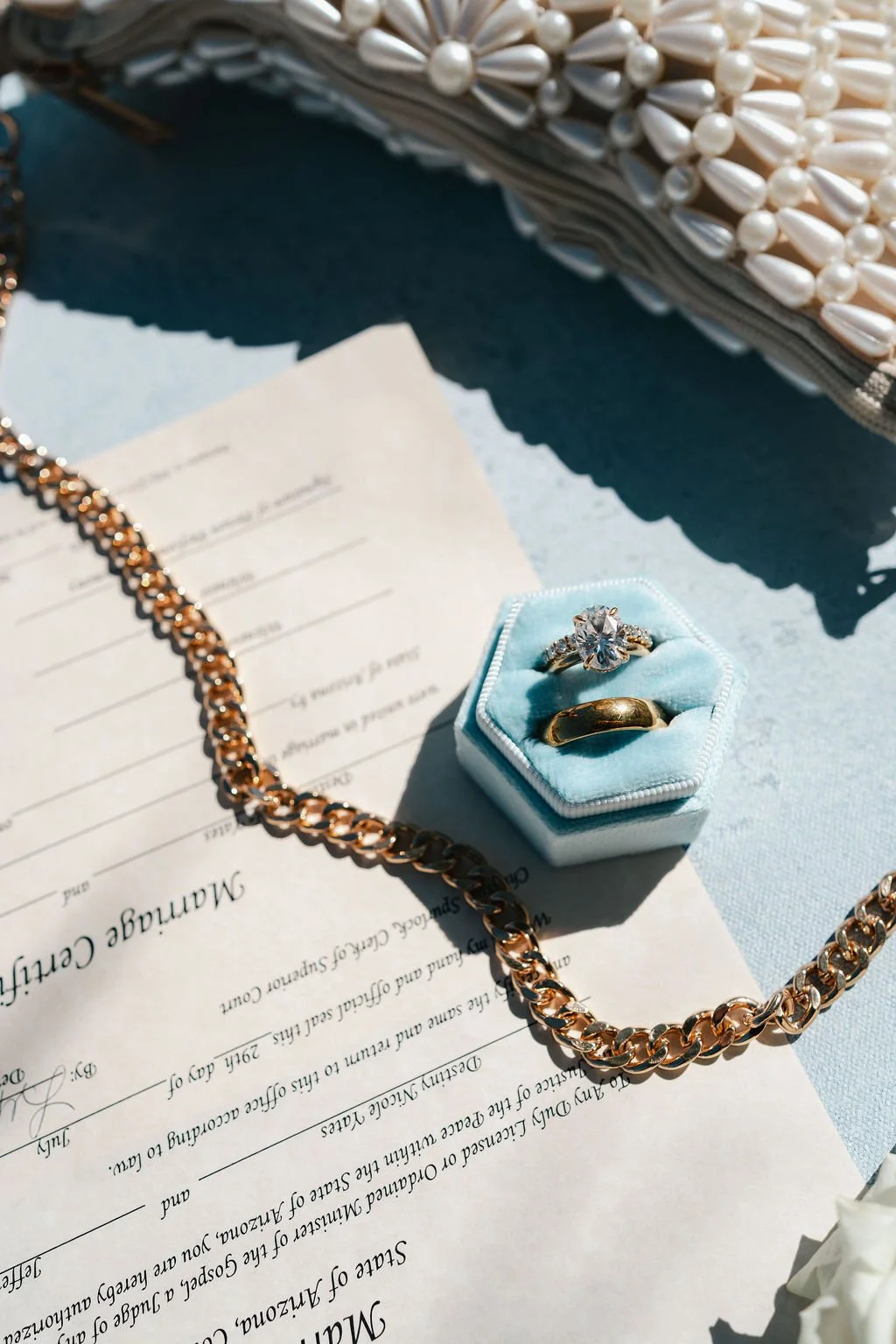
Every element in this frame, the velvet ring box, the gold chain, the marriage certificate, the pearl clutch, reads richer because the surface beneath it is absorbing light rather than bouncing it. That is what a hand-painted canvas does that no vinyl or acrylic flat lay surface can replicate. The shadows are real. The depth is real. The difference is the surface.
Silver reflectors positioned opposite the key light provide controlled fill without the color contamination that gold reflectors introduce. White reflectors produce softer, more subtle fill. For platinum and white gold work on a Silt or Slate canvas, silver reflectors are the standard choice because they maintain the cool color temperature of the metal.
The canvas contributes its own fill behavior. Where a white acrylic surface would bounce hard fill light upward into the underside of the piece (often creating an unnatural glow beneath a raised setting), the painted canvas returns a softer, warmer, more diffused fill. This is why ring shots on canvas have a grounded, dimensional quality that the same ring on white acrylic lacks. The light under the stone comes from the surface, but it arrives gently, shaped by the canvas texture rather than fired back at full intensity.
Overhead Flat Lay vs. Styled Scene: Two Approaches to Jewelry Product Photography
Luxury jewelry photography divides naturally into two compositional modes, and the surface requirements differ for each. Understanding when to use a flat lay surface versus a backdrop canvas, and how each shapes the final image, is the difference between a versatile product photographer and one who delivers the same frame regardless of the brief.
The overhead flat lay is the language of catalog, e-commerce, and social media. The camera looks straight down. The jewelry is arranged on a horizontal surface, often with styling props: a linen ribbon, a sprig of dried botanical, a handwritten note card. For this approach, Chasing Stone's hand-painted flat lay surfaces and fabric flat lays provide the textured, non-reflective ground that overhead work demands. The San Miguel and Joshua Tree hand-painted flat lays, in particular, offer the kind of organic surface variation that makes overhead jewelry arrangements feel curated rather than clinical.
The styled scene is the language of editorial, campaign, and brand storytelling. The camera is positioned at eye level or slightly above. The jewelry is displayed on a surface or worn by a model, with the backdrop canvas providing the environmental context. This is where the larger hand-painted backdrops, the 5x8, 8x10, or 8x14 ft canvases, define the image's mood and atmosphere. A gold chain draped across a velvet-covered form, shot against a Sandstone canvas, tells a fundamentally different story than the same chain photographed flat on a white surface. The backdrop transforms the image from product documentation into brand narrative.
The most comprehensive jewelry photography portfolios include both approaches. For photographers expanding into luxury product work, the investment path is clear: start with one flat lay surface for overhead catalog work and one backdrop canvas for styled editorial, then build the collection as client briefs diversify. Our complete flat lay photography guide covers the overhead technique in depth.
Styling the Set: Props, Negative Space, and the Canvas as Creative Collaborator
In luxury jewelry photography, the surface is not a background. It is the largest visual element in the frame after the piece itself, and its relationship to the subject determines whether the image reads as aspirational or accidental. The most accomplished product photographers treat the hand-painted canvas the way a set designer treats a stage: as an active participant in the visual narrative, not a neutral container.
Negative space is the primary compositional tool. A single ring positioned in the lower third of a Carbon canvas frame, with the remaining two-thirds given over to the dark, textured surface, creates the kind of visual tension that luxury advertising depends upon. The emptiness is not wasted space. It is the silence that makes the object speak. Our exploration of negative space and minimalist composition with backdrops applies directly to product work.
Props, when used, must operate at the same register as the jewelry. A $12,000 diamond necklace does not share the frame with a grocery-store flower. It shares the frame with a single stem of garden rose, a fragment of handmade paper, a length of raw silk, or nothing at all. The canvas provides enough visual interest that minimal propping, or no propping, is often the strongest choice. Where a plain white surface demands props to avoid sterility, a hand-painted canvas with its organic variation and tonal depth can carry the frame entirely on its own.
This is where Jennifer's artistry intersects directly with the product photographer's intent. Each canvas has areas of greater and lesser textural intensity, passages where the brushstrokes are more visible and areas where the surface smooths to a near-solid tone. An experienced stylist learns to read the canvas and position the jewelry in the zone that serves the composition: a highly textured area for grounding a bold statement piece, a smoother area for letting a delicate chain float without competition.
From Studio to Post-Production: How Canvas Reduces Your Retouching Workload
The downstream benefit of shooting jewelry on hand-painted canvas reveals itself in the editing suite. Because the surface absorbs rather than reflects light, the raw files arrive with cleaner shadow detail, fewer blown highlights, and a broader tonal range than the same piece shot on vinyl or acrylic. This translates directly to reduced retouching time, which is the single largest variable cost in high-volume product photography.
On a reflective surface, the retoucher spends significant time cloning out hot spots, masking unwanted reflections, and color-correcting areas where the surface's specular bounce contaminated the jewelry's color. On canvas, those problems largely do not exist. The retoucher's time is spent on the work that actually matters: fine-tuning metal luster, enhancing gemstone fire, and ensuring color accuracy across the collection.
For studios billing per-image retouching fees (typically $5 to $25 per image for jewelry, depending on complexity), the reduction in surface-related retouching can save hundreds of dollars per campaign. Over a year of commercial product work, the hand-painted canvas effectively pays for itself in retouching savings alone, before accounting for the qualitative difference in the final imagery.
Color grading in Lightroom or Capture One is similarly simplified. The canvas provides a consistent, neutral-to-warm or neutral-to-cool base tone (depending on colorway) that responds predictably to global adjustments. When you shift the temperature slider, the canvas moves in harmony with the jewelry rather than pulling in an unexpected direction. This predictability is the hallmark of a professional-grade surface.
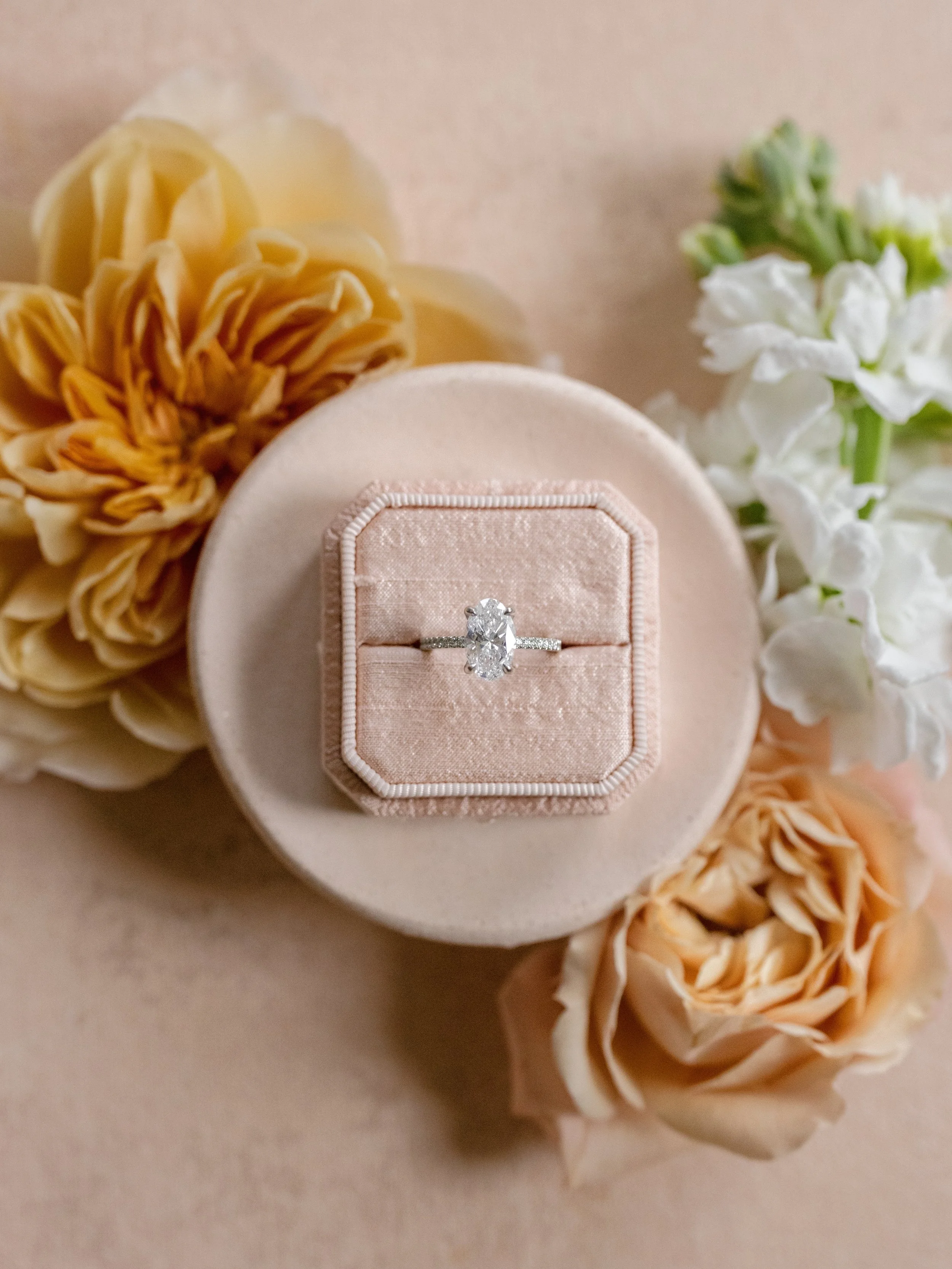
Shooting a bridal jewelry campaign this season? Chasing Stone's Sandstone flat lay surface is in stock now and this is exactly what warm florals and diamond rings look like against it. Every tone in this frame is working together. Shop at chasingstone.com.
Frequently Asked Questions
What is the best backdrop color for photographing gold jewelry?
Warm earth-tone backdrops like Clay, Sandstone, and Limestone complement yellow gold's inherent warmth by providing harmonious reflected fill light that deepens the metal's luster without shifting it orange. For rose gold, Chasing Stone's Rose-Quartz and Rhodonite hand-painted canvases harmonize with the copper-alloy undertones. Avoid cool-toned surfaces for gold, as they create a visual temperature conflict that makes the metal appear dull.
Can you use a hand-painted canvas backdrop for jewelry e-commerce photography?
Yes, and leading luxury jewelry brands increasingly do. While pure white backgrounds remain standard for marketplace listings (Amazon, Etsy) that require isolated product images, brand-owned e-commerce sites benefit from the visual richness and brand differentiation that a hand-painted canvas provides. Chasing Stone's neutral colorways like Silt and Limestone offer clean, non-distracting backgrounds that work for e-commerce while adding the tonal depth that a plain white surface lacks.
What camera settings should I use for jewelry photography on a textured backdrop?
Set your aperture to f/8 to f/11 for optimal depth of field across the jewelry piece while rendering the canvas texture perceptibly but not distractingly. Keep ISO at 100 to eliminate noise that becomes visible at the extreme magnification levels jewelry photography demands. Use an 85mm to 105mm macro lens on a tripod, and shoot tethered to evaluate focus accuracy at 100% on a calibrated monitor.
How does focus stacking work for jewelry on canvas backdrops?
Focus stacking involves capturing three to fifteen frames of the same jewelry piece, each focused at a different depth plane, then blending them in software (Helicon Focus, Zerene Stacker, or Photoshop) to produce a single image with edge-to-edge sharpness. Hand-painted canvas is particularly well suited to focus stacking because the organic texture variation disguises the blend boundaries between frames, producing a more natural-looking composite than smooth or uniform surfaces allow.
How much do hand-painted backdrops for jewelry photography cost?
Chasing Stone's hand-painted canvas backdrops begin at $497 for a 5x8 ft surface, with 8x10 ft canvases at $797 and 8x14 ft full-length surfaces at $1,197. Three-pack bundles offer meaningful savings (a 5x8 three-pack is $1,371 at bundle pricing). Each canvas is hand-painted by artist Jennifer over two to three days on premium cotton canvas in California, making each piece a one-of-a-kind surface that no two studios share.
What is the difference between a flat lay surface and a backdrop for jewelry photography?
Flat lay surfaces are designed for overhead photography where the camera looks straight down at the jewelry arranged on a horizontal surface, ideal for catalog shots, social media flat lays, and collection overviews. Backdrop canvases are designed for eye-level or angled photography where the canvas hangs vertically behind the subject, ideal for styled editorial scenes, campaign hero shots, and environmental compositions. Most professional jewelry photographers maintain both surface types for full creative range.
Do hand-painted backdrops reduce jewelry retouching time?
Significantly. Because hand-painted cotton canvas absorbs light rather than reflecting it, raw files captured on canvas arrive with fewer hot spots, cleaner shadow detail, and a broader tonal range than those shot on vinyl or acrylic. Studios report meaningful reductions in surface-related retouching when switching from synthetic to hand-painted canvas, with per-image retouching fees for jewelry typically ranging from $5 to $25 depending on complexity.
The Surface Beneath the Stone
Luxury jewelry photography is, at its core, the art of controlling light in service of an object that was itself designed to control light. The backdrop is not peripheral to that equation. It is foundational. A hand-painted canvas from Chasing Stone absorbs, diffuses, and returns light in ways that elevate the jewelry rather than competing with it, providing the tonal depth and textural dimension that separate images destined for the pages of a luxury publication from those that disappear into the scroll of a social media feed.
Every canvas in the Chasing Stone collection is hand-painted by Jennifer in California, a process that takes two to three days per piece and produces a surface as singular as the jewelry it is destined to support. No two canvases are identical, because no two paintings are identical. This is not a limitation. It is the defining characteristic of handmade work, the same principle that gives a jeweler's one-of-a-kind creation its value over a mass-produced imitation.
For photographers ready to bring this level of surface quality to their product work, explore the full backdrop collection or reach out to us directly at info@chasingstone.com for guidance on building a product photography surface kit tailored to your client roster.
Creators of premium photography backdrops and styling surfaces
Trusted by thousands of discerning creatives worldwide
Every piece is handcrafted with intention in Orange County, California